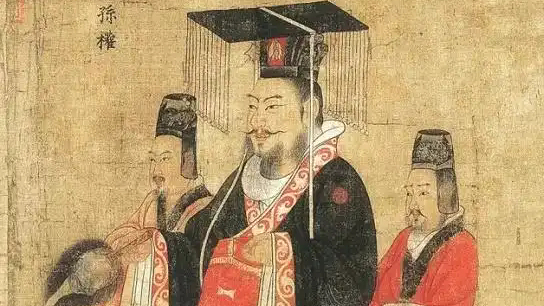
Sun Quan
Introduction
Sun Quan, born in 182 AD and died in 252 AD, was a prominent and influential figure during the Three Kingdoms period (220-280 AD) of ancient China. He was the founder and first emperor of the state of Eastern Wu (222-280 AD), one of the three major states that existed during this turbulent era. Known for his strategic acumen and leadership qualities, Sun Quan played a significant role in shaping the history of the Three Kingdoms.
Early Life and Rise to Power
Sun Quan was born in the late Eastern Han Dynasty in Fuchun county, now part of modern-day Fuyang district in Hangzhou. He was the second son of Sun Jian, a distinguished general who served under the warlord Yuan Shu. After the death of Sun Jian in battle, Sun Quan's elder brother, Sun Ce, took over the family’s leadership, setting the foundation for the establishment of their own power base in Jiangdong, south of the Yangtze River.
Sun Quan was initially overshadowed by his older brother Sun Ce, who was known for his martial prowess and ambition. However, Sun Ce's untimely death in 200 AD thrust the young Sun Quan into a leadership position. At the age of 18, Sun Quan inherited his brother's domain and quickly proved himself to be an astute and capable leader, consolidating his power and gaining the loyalty of talented advisors and generals.
Leadership and Governance
Sun Quan's rule was characterized by his pragmatic approach to governance and his ability to attract and retain talented individuals. He wisely entrusted administrative and military matters to capable subordinates, such as Zhang Zhao, Zhou Yu, and Lu Su. This delegation of responsibilities allowed him to focus on the broader strategic picture and maintain stability within his territories.
One of Sun Quan's most significant achievements was his role in the alliance with Liu Bei against the powerful warlord Cao Cao. This coalition culminated in the famous Battle of Red Cliffs in 208 AD, a decisive engagement that halted Cao Cao's southward expansion and ensured the survival of Sun Quan's nascent state of Eastern Wu.
Establishment of Eastern Wu
In 229 AD, after years of consolidating his power and expanding his territories, Sun Quan declared himself the Emperor of Eastern Wu, establishing Nanjing (then known as Jianye) as his capital. His reign as emperor was marked by efforts to strengthen his state through economic development, fostering trade, and encouraging agricultural advancements.
Sun Quan also focused on naval power, recognizing the strategic importance of controlling the Yangtze River and the surrounding waterways. Under his leadership, Eastern Wu became a dominant naval force, which was crucial for defending against invasions and conducting military campaigns.
Legacy
Sun Quan ruled Eastern Wu until his death in 252 AD. His reign laid the groundwork for the continued existence of Eastern Wu as an independent state until its eventual conquest by the Jin Dynasty in 280 AD. Sun Quan is remembered as a wise and pragmatic ruler who navigated the complex political landscape of the Three Kingdoms period with skill and foresight.
He was known for his ability to form alliances and manage relationships with other warlords and his emphasis on governance and economic development. Sun Quan's legacy is reflected in the cultural and historical narratives of the Three Kingdoms, particularly in the classic Chinese novel "Romance of the Three Kingdoms," where he is depicted as a capable and strategic leader. Photo Gallery(1 picture)CategoriesHistoryTagHistorical FiguresAncient Chinese HistoryRelatedZhuge LiangBattle of Red Cliffs36 Strategies: Pretend to Advance Down the Path While Taking Another Hidden PathPeking Opera 'Red Cliff'Catalogue1. Introduction2. Early Life and Rise to Power3. Leadership and Governance4. Establishment of Eastern Wu5. Legacy- - - []








